
How does the repeater work?
When using two-way radios or wireless communication systems, one of the most common questions is: how does the repeater work? A repeater plays a crucial role in extending the communication range, ensuring that signals remain strong and clear even in areas where direct communication is difficult.
What is a repeater?
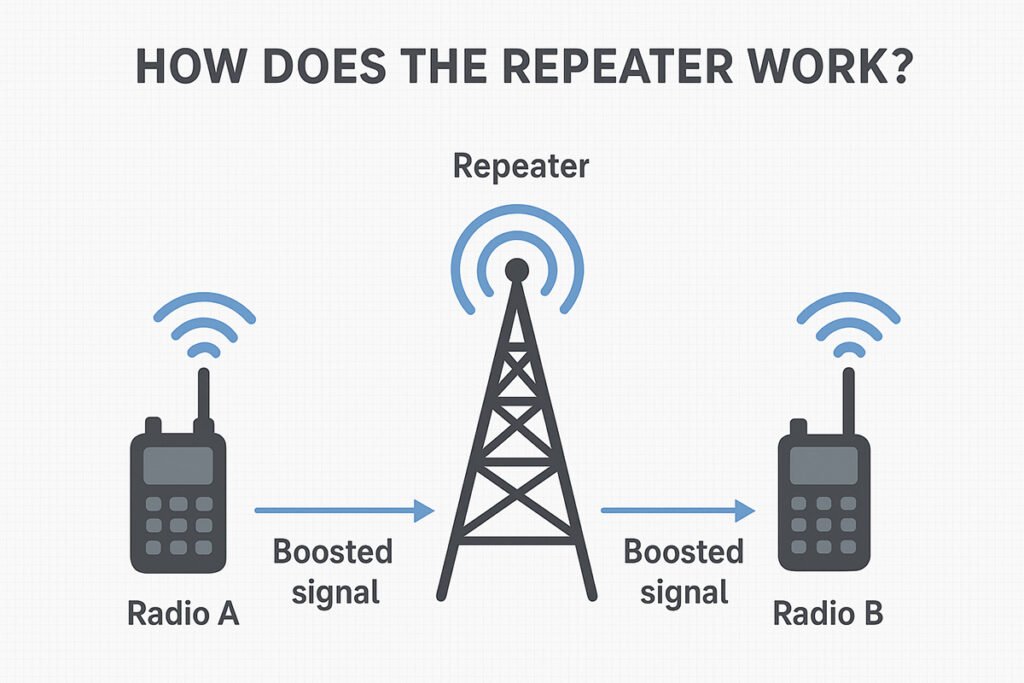
A repeater is a specialized radio device that receives a signal on one frequency and retransmits it on another frequency. This process helps overcome natural barriers such as buildings, hills, or long distances, which would otherwise weaken or block radio signals.
Think of it as a “bridge” between radios: without a repeater, two radios might only reach a few kilometers in open terrain. With a repeater, the same radios can cover dozens of kilometers—sometimes up to 50–100 km, depending on terrain and antenna setup.
How does a repeater work step by step?
- Signal reception – The repeater’s receiver picks up the radio transmission on its input frequency.
- Signal processing – The repeater instantly cleans and amplifies the signal, removing noise or distortion.
- Signal retransmission – The repeater transmits the improved signal on its output frequency at higher power.
- Coverage extension – Because repeaters are usually installed on high towers, rooftops, or mountain tops, the retransmitted signal can travel much farther and reach multiple users.
Why are repeaters important?
- Extended range: Essential for large construction sites, oil & gas fields, mining areas, and urban environments.
- Reliable communication: Ensures messages are clear and uninterrupted, even with obstacles in the way.
- Scalability: Multiple teams and departments can connect through one central repeater system.
- Safety: In critical industries, instant communication can save lives.
Common applications of repeaters
- Public safety (police, fire, ambulance)
- Industrial operations (oil, gas, mining, construction, utilities)
- Transport & logistics (airports, ports, trucking fleets)
- Event management (sports events, festivals, exhibitions)
Common user concerns and solutions
| User Concern | Challenge | Solution with Repeater |
|---|---|---|
| “My radios don’t reach across the whole site.” | Direct communication is blocked by buildings or terrain. | Install a repeater on a tall structure to extend coverage. |
| “Signals are noisy and unclear.” | Weak transmission gets distorted. | Repeater amplifies and retransmits a cleaner, stronger signal. |
| “We need communication between multiple teams.” | Direct radio-to-radio communication is limited. | Repeater allows multiple groups to connect through one system. |
| “We work in dangerous areas.” | Safety depends on reliable communication. | Repeater ensures emergency calls are always transmitted clearly. |
A radio repeater is the backbone of reliable long-range communication. By amplifying and retransmitting signals, it allows two-way radios to cover much greater distances and maintain clear communication even in complex environments.
If your business requires stable and long-distance communication solutions, we can provide professional-grade repeaters and walkie talkie systems tailored to your needs. 👉 Contact us today to request a quote or get a customized communication solution.